dayoutlast is a record of my direct engagement with mostly contemporary art, mostly Los Angelean.

As this blog has evolved since its 2010 inception, so has my perspective. What I once perceived as central within the investigation was what was central, literally, within the photographic frame that I shared here. While still an important consideration, such thinking has also given way to more peripheral considerations, ones also accompanied occasionally by text (written manifestation of thought) and the oscillations between them. What's missing here are larger unknowns surrounding issues of presentation and representation; the amount of time and space it actually takes to accomplish such first-hand observations; and the quandaries between documentation and interpretation.

Despite my attempt to communicate here with image and text what is essential in some respect about the artwork, neither representation should ever be considered a substitution for the primary viewing experience. Of course, occasionally there are exceptions.

Most of the time, these posts are merely remnants---residual fragments---from my last day out.

Thursday, August 30, 2018

"POETIC STRUCTURE: ART + ENGINEERING + ARCHITECTURE – Skidmore, Owings & Merrill LLP" @ MAK Center for Art and Architecture, Los Angeles at the Schindler House


Atelier Peter Zumthor
LACMA: Building for the Permanent Collection, design as of April 2017


Jean Nouvel, LACMA proposal, 2001


The two images directly above are of Jean Nouvel's LACMA proposal from 2001. They were not part of this exhibition; I just found myself thinking about Nouvel's proposal (as I also do from time to time)  in the context of this exhibition here. I thought that Nouvel did a nice job of proposing the integration of past and present elements with an eye for the future; it doesn't take much to get above the skyline to appreciate the expanse that is Los Angeles, and his rooftop sculpture garden would have done well and then some.  Alas, a community too quick to strike the set quickly rather than deal with the the real challenges of organic growth continues to bury history even as LACMA's current site strives to become uncovered, at least geologically speaking. But I digress... And so much has changed in almost twenty years.


Discrete... Continuum...


Underwear, cod pieces or roof structures?


Sometimes it's also not difficult to take notice of certain elements of the Schindler House, perhaps heightened either by the exhibition or by the luminous moment in time.  Here, the patina on the brass flashing for a built-in fireplace served as an attraction/distraction/palette cleanser for an otherwise monotone and controlled, entirely didactic architectural exhibition based on the "poetic structure" of such areas.  I wasn't able to capture the poetics within the framework of the exhibition itself per se, but rather, again, by its contrast with the Schindler House itself. Sometimes, the exhibitions housed within the Schindler house integrate and amplify one another; sometimes they don't.  I suppose grimy hands and handprints is a gray area to this concern...


And here are a few exterior shots of the Schindler house, a reminder that some structures are less vulnerable to the Los Angeles, architectural fashion changes That said, the buildings on either side (likely inspired directly/indirectly by the Schindler House) loom in such a crowding way, which is to say that even those as generative as this one are not entirely beyond encroach, thankfully not obliteration in this instance.


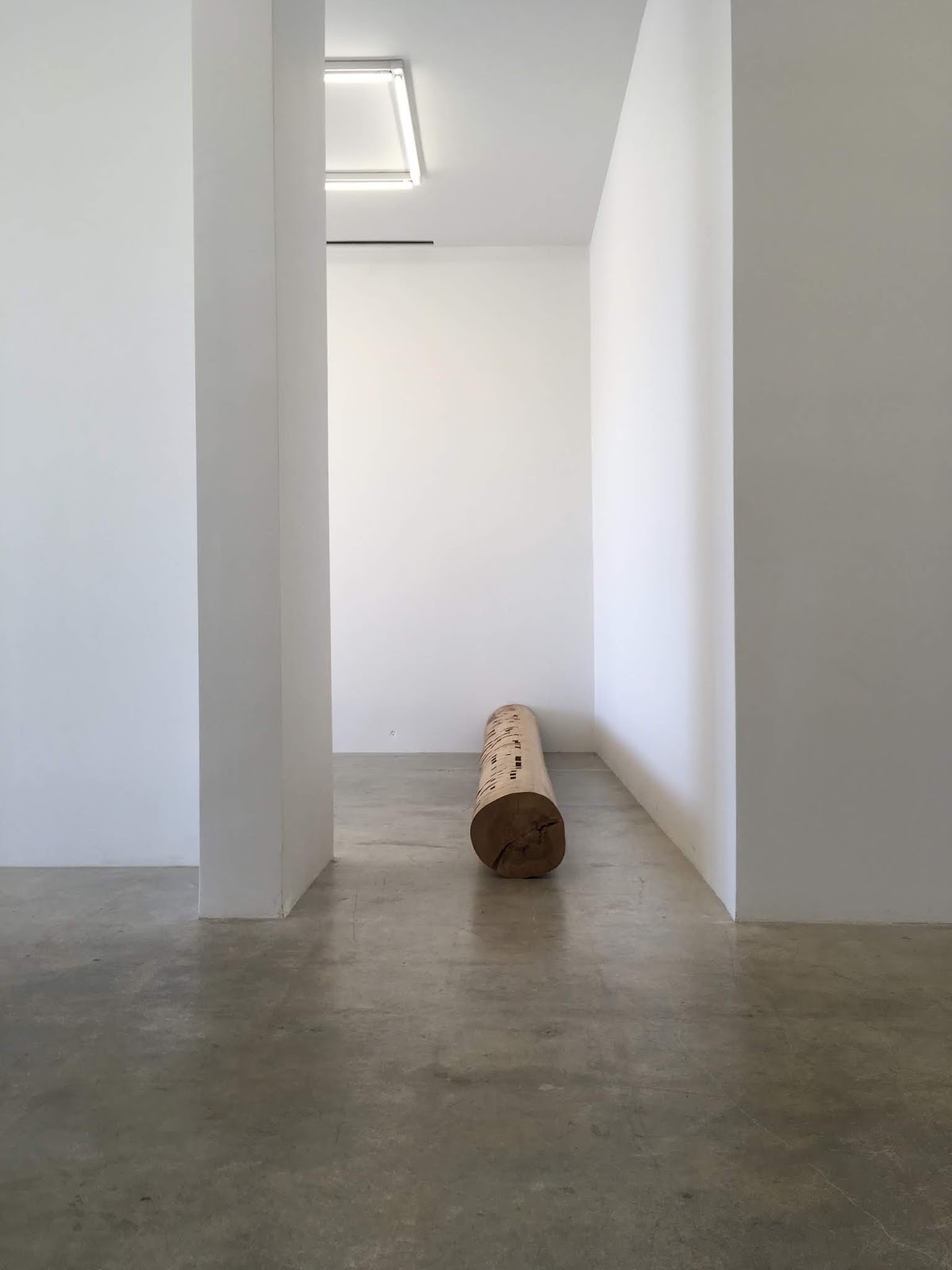
Kazuo Kadonaga "Wood / Paper / Bamboo / Glass"@ Nonaka-Hill


Wood No. 5-CI, 1984


The essence of both paper and wood is considered as layers expand from a center and contract from the outer age, both as a function of artist and time.


Wood No. 5-CI, 1984


Wood No. 8-D, 1977


The decaying rhythms of time can be observed but only in the time of tis decay.


Bamboo No. 1-B, 1984


This incidental observation of this suspended drop of sap on the armature for Bamboo No. 1-B somehow contrasts with the longer duration that most of these works endure to become what they are while also reminding of how closely looking must be sometimes. Honestly, this sap drop has no artistic intent, but somehow punctuates the viewing experience as does Glass No. 4-I. Both examples drop/fall with gravity, accumulate, and form over time, again from a center in time with cooling effects.


Bamboo No. 1-B, 1984


Paper No.1-BF, 1983


Glass No. 4-I, 1999


Time moves at different rates and different directions and through different spaces both independently and of artistic collaboration.

"This Brush for Hire: Norm Laich & Many Other Artists" @ Institute of Contemporary Art | Los Angeles


Daniel Joseph Martinez
Divine Violence, 2007
Sixteen layers of gold enamel automotive paint
on panel with matte black hand lettering
20 parts: 24 x 36 (60.1 x 91.2cm) each
Overall dimensions variable


Kim Fisher
No. 5, No. 19, and No. 22, 1996
Oil on linen
12 x 12 in (30.5 x 30.5 cm) each


John Baldessari
A Painting That Is Its Own Documentation, 1966-1968
Acrylic paint on multiple canvases
6 panels: original canvas 68 x 56.625 x 1 in (172.7 x 144 x 2.5 cm)
5 additional canvases: 34.25 x 56.625 x 1 in (87 x 144 x 2.5 cm)
Overall Dimension: 68 x 226.625 x 1 in (172.72 x 575.31 x 2.54 cm)


Lawrence Weiner
AS LONG AS IT LASTS, 2018
Language + the materials referred to
Dimensions variable


stills from a short film about Norm Laich
Directed and Produced by Pauline Stella Sanchez


Arturo Herrera
Park and Ride, 2018
Dimensions site specific