dayoutlast is a record of my direct engagement with mostly contemporary art, mostly Los Angelean.

As this blog has evolved since its 2010 inception, so has my perspective. What I once perceived as central within the investigation was what was central, literally, within the photographic frame that I shared here. While still an important consideration, such thinking has also given way to more peripheral considerations, ones also accompanied occasionally by text (written manifestation of thought) and the oscillations between them. What's missing here are larger unknowns surrounding issues of presentation and representation; the amount of time and space it actually takes to accomplish such first-hand observations; and the quandaries between documentation and interpretation.

Despite my attempt to communicate here with image and text what is essential in some respect about the artwork, neither representation should ever be considered a substitution for the primary viewing experience. Of course, occasionally there are exceptions.

Most of the time, these posts are merely remnants---residual fragments---from my last day out.

Friday, January 29, 2016

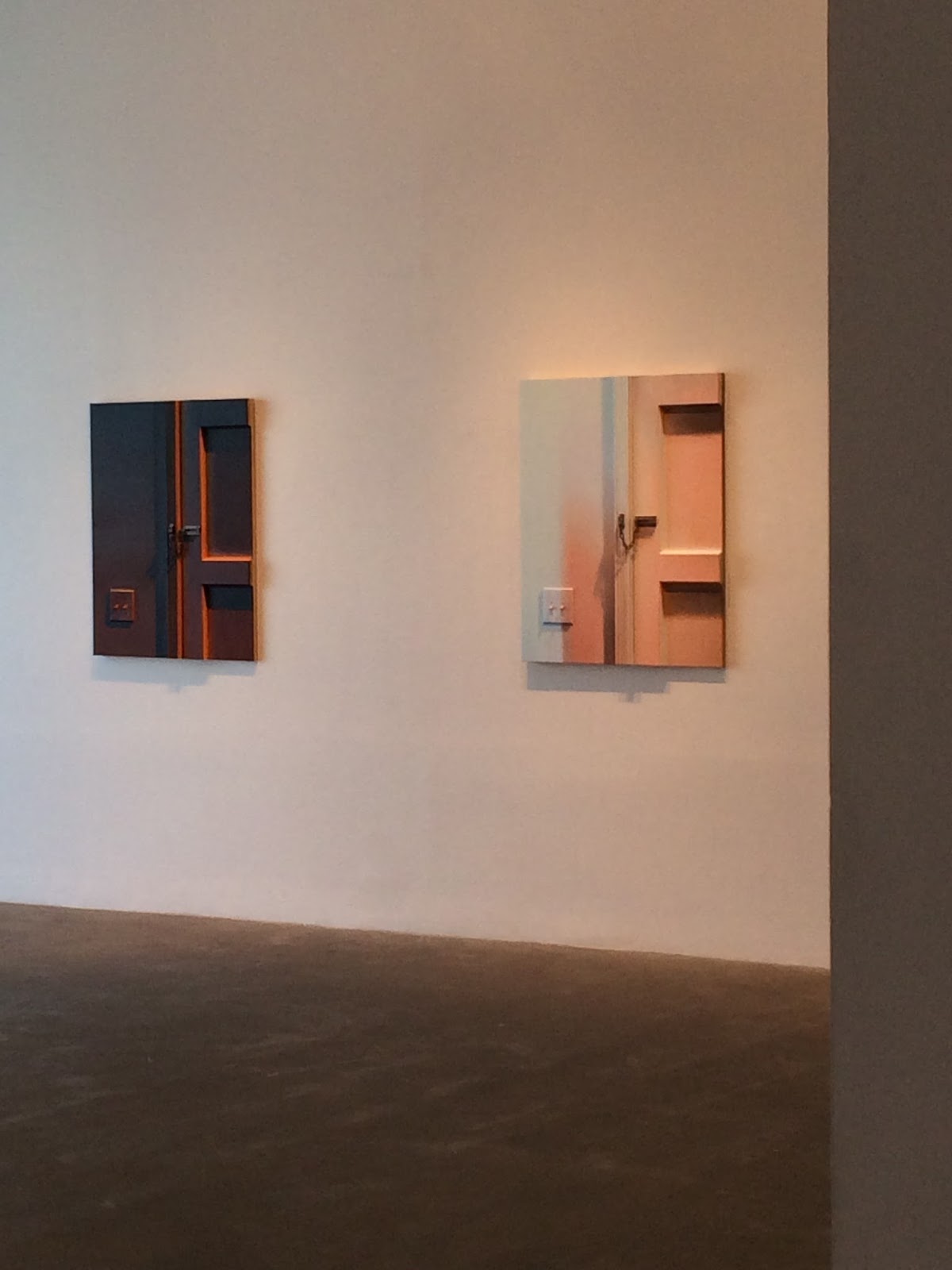
Michael Henry Hayden @ ACME


Untitled, 2015
oil on wood, acrylic, and brass


Untitled, 2015
acrylic, paper, aqua resin, fiberglass, wood
84 x 47 inches


Untitled, 2014
oil on wood, acrylic, and brass


Who doesn't love the color of shadows and what they suggest about presence/absence and time?Blinds and doors are opaque, architectural features that prevent the passage of light or any sense of depth or knowing. They are a block between inside and out. So, what does it mean to convert a dynamic moment into a static one besides an excuse to make art objects? Light’s on but nobody’s home OR light is off and somebody’s home. Polyphemus was once involved in that kind of game too. Trickery. Trompe l'oeil. Painting. Object. Reproducing a moment in time with light and shadow. After one or two, they all start to look the same and so seem a bit one-trick pony. Good to know. And so, I find myself thinking more about Katie Sinnott’s "Gateway," her recent installation within the same spaces. See here

All said, the cast blind seems worth contemplating.

Ana Prvacki "Stealing Shadows" @ 1301PE


Stealing Shadows, Duchamp, 2007
Medium variable
Dimensions Variable
$16,000.00


Stealing Shadows, Bourgeois, 2007
Medium Variable
Dimensions variable
$281,650.00 

Phil Argent "Misaligned" @ Shoshana Wayne


Untitled (Mind the Gap), 2015
Acrylic on canvas
84” x 72” x 1 1/2”


Untitled (Endless Fences II), 2014
Acrylic on canvas
72” x 56” x 1 1/2”


Untitled (Waffle cone), 2014
Acrylic on canvas over panel
35” x 27” x 2”


Sea Within a Sea (Shadow), 2014
Acrylic on canvas
84” x 72” x 1 1/2”


Untitled (Sick Glass), 2014
Acrylic on canvas
72” x 56” x 1 1/2”


Untitled (Monster), 2015
Acrylic on canvas over panel
23” x 21 1/2” x 2“


Untitled, 2014
Acrylic on canvas
70” x 50” x 1 1/2”


Untitled (Displaced), 2015
Acrylic on canvas
40” x 30” x 1 1/2”


Untitled (Scuttle), 2015
Acrylic on canvas
40” x 30” x 1 1/2”


Untitled (Drift is OK), 2015
Acrylic on canvas
40” x 30” x 1 1/2”


Key Ingredient, 2015
Acrylic on canvas
38” x 52” x 1 1/2”

What it proposes about surface interaction in terms of communication (interlocking potentials and irregularities). Sometimes a fit, sometimes not. But color connects and verifies, clarifies. That said, the pictures here function more as diagram than pure visual effect of said communication.  That is to say, they illustrate the points without much of them being the points. Imagistic, photographic/print-oriented facture. Pictorial digital interface. Video game movement a la Pac Man meets Mondrian. And the watery sign of painting. Organic, fluid process meets, interacts, and integrates with orders, logical systems and signs. Zipper effect. Interlocking edges (human made and natural) attempting to suture the way logic and emotion might, if we could be visualizing such a relationship here. Yes.  Layers and Windows onto worlds. Touches, smears, and departures. Catch and release. Snapshot engage. Postulating an opening onto infinite. What acrylic paint can do. Flatten and refer to artificial color and industrial era. What can it now say in a post-digital age of painting? Somewhere between psychedelic haze (posters) and current light-based technologies (phones, tablets, et al). Just a little too graphic for my tastes ultimately, but what isn't anymore? Explode, cut and tear. Collage. Jane Callister. Kim Fisher. Distant Warholian palimpsest in terms of style (print decay. repeated painting).  Balancing forces uprightly in orientations and so reference to human portrait with occasional landscape.

Saturday, January 23, 2016

Chris Bradley "Ceilings" @ Shane Campbell Gallery, Chicago


I tend to notice ceilings in art spaces and how they influence the reception of work within.  I like work that asks me to think about this physically in the present as well as metaphorically about present notions of a word "ceiling" as well as the more reflective bits about what it represents in the past, brick and mortar venues, sites of human congregation and revelry. Somehow these connect to Pierre Hugyhe's  "L'Expedition cintillante, Act 2 (light show), 2002" as a miniature performative space of light and sound where and when the audience is a strange participant in terms of scale and temporal displacement. The lights are on, but nobody's home.  Not only does this take a literal dimension in terms of stage lighting without performers (wherein the assumption is that the viewer is said audience) but also metaphorically as it refers to spaces once congested with human interaction, marketplaces (galleries) for example. So, the work reflects its site of reception.


Pierre Huyghe
 L'Expedition cintillante, Act 2 (light show), 2002. 


Ania Jaworska "Cynic Architectures" @ Museum of Contemporary Art Chicago