Torn between land and sky...


Rothko...


Shark bites...


Dark and murky...
Leviathan...

Alchemy and emergence...
Breach...


Placid and overcast...
Moody to be sure...
Opacity too...
Cf. "Milk Bottle" flatness...


Northeast/Southwest...
Classic North American tale...
Rise and fall...
Rise and set...
Certainly, puzzles worth pondering...


The past tense of see is saw. See-saw.


I became more interested with Joe Goode in the context of the Getty's Pacific Standard Time: Crosscurrents in L.A. Painting and Sculpture, 1950–1970 exhibition from 2011-2012. Anything else I had seen previously, something from the Milk bottle series for example, was less interesting to me. This lack was set aside when I saw Torn Cloud Painting, 73 from 1972 (see below) at the Getty.


Much like the Milk bottles, Goode was concerned with surface quality, but now it was something more open-ended, more abstract, something poetic and derived from the landscape, not so seemingly just an academic comparison between two and three dimensions, one that persists currently with Flat Screen Nature. (A similar thing happened for me, by the way, with discovering Ron Davis during PST. In both instances, the acknowledgement of space as rough around the edges seemed significant during a time when most artists were more concerned with hard, controlled edges. Think instead of an old pair of shoes or better yet, a T Shirt worn thin and frayed at the collar perhaps, but I digress). The point is that Torn Cloud embraced imperfection and was now shaping my current view of Goode’s most recent work. That his approach to the land of Southern California was not so glossy, and that his approach to such eccentricities explore the potential of both flat and deep space simultaneously is important formally as art but also as one's vision.
So, noting the torn edges of the aluminum panels in this grouping of paintings for Flat Screen Nature seems straightforward enough. Then, the next question is how this same element might be considered for the painted surface itself as well as what that might have to do with pictorial landscape, one evenly signified in most instances with horizon at center? A fragment of worn history, geological weathering and erosion come to mind, both functions of heat and water, things often depicted as warm or cool respectively. Hence, sunset over the water, also the quintessential edge of North America, especially as far as California is concerned. Or conversely, worn surfaces, textures, painted objects, fat over lean, and so on...
To make work in Los Angeles and to look at the distant horizon for as much time as Goode has, one can appreciate how the occasion of clouds (celestial objects taking for granted in more temperate climes; think Dutch or even midwestern skies) influence the perception of sky, land, and space. For, the presence of direct light will produce a sense of depth actually, not just between an object on the floor (Milk bottle) and the wall (coordinately colored painted surface) but also within a painted/carved object itself like any one of the works shown here. On the other hand, filtered light from clouds, for example, will complicate a sense of depth with objects appearing flat. Fewer in this show display as much. Because the weather never seems to change in Southern California externally (hence the lack of clouds most of the time), one starts to wonder about how this functions internally and shapes the artist's outlook and expression (a discussion for another time).
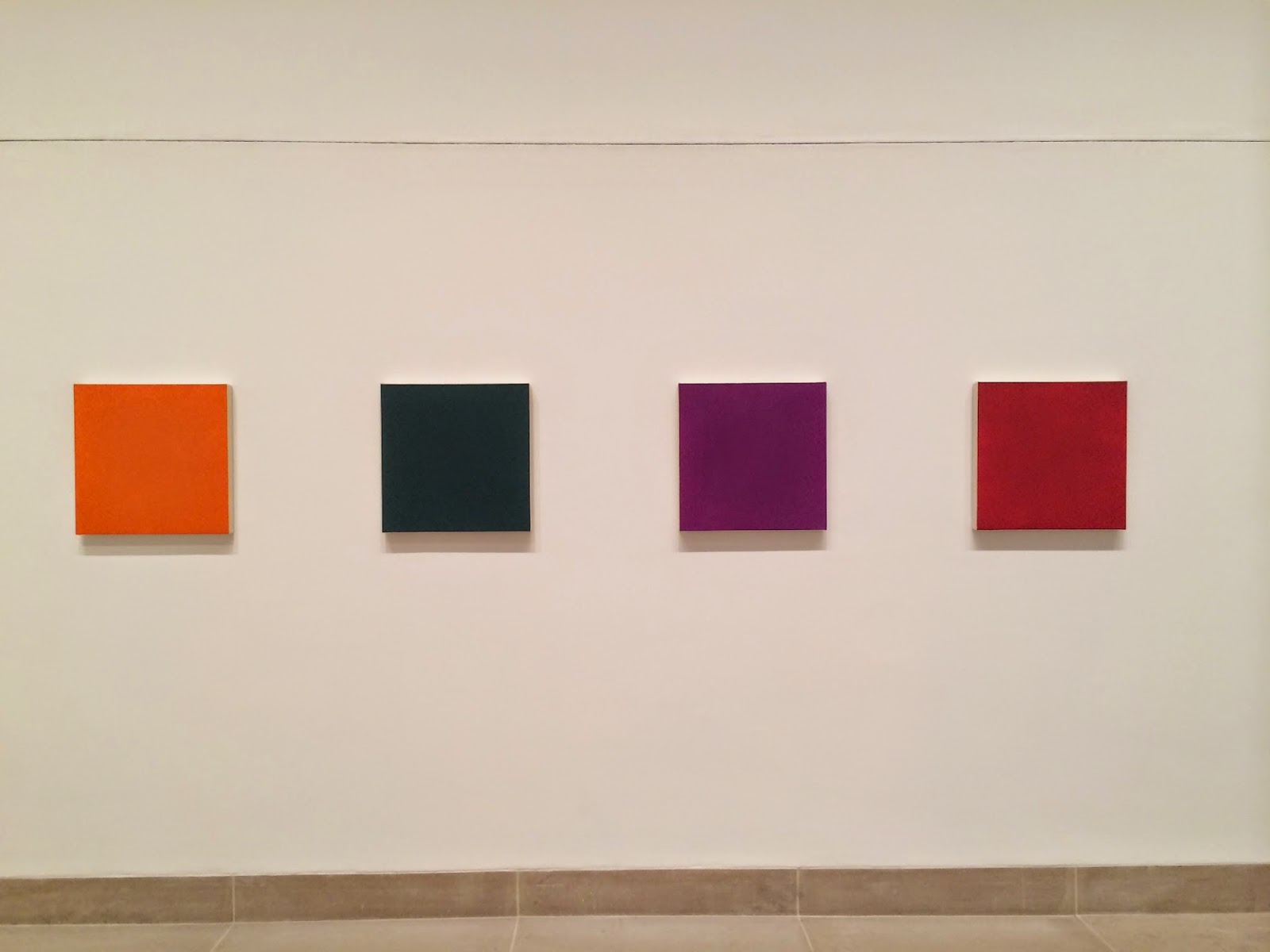
In very formal terms, I began my viewing thinking about Goode's Flat Screen Nature relationships to Rothko. It was really hard to ignore the more or less squares of similar size, divided horizon and moody applications of paint of a similar tone and register. By the time I had finished, I thought more about Ellsworth Kelly, certainly as it pertains to fragment, articulated edges, and even size (the smaller works). I also couldn't help but wonder what Kim Fisher would have thought, despite the fact that her torn fragments stem from fashion, fashionable objects, and representations thereof as opposed to landscape nature. Come to think of it, these relationships between weather and fashion might be more interesting than what the surface allows most days. Not just functions of currents in more diverse climes weather wise, it is persistently challenging to figure out how much of our nature is human and how much is beyond our horizons.